Pull, Listen, Repeat: Thirty Days Up the Tower With the Tuesday Ringers
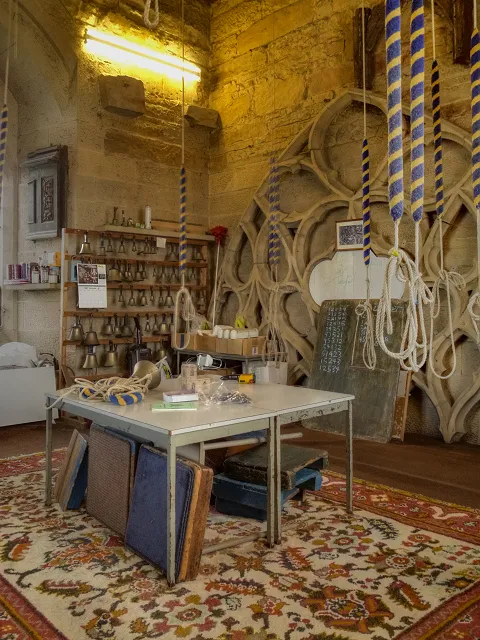
Photo: David Dixon , CC BY-SA 2.0, via Wikimedia Commons
The first thing you notice is not the bells. It is the rope. It hangs down through a hatch in the ceiling like something out of a Victorian novel, thick and slightly hairy, with a coloured woolly bit near the bottom called the sally. You are told to stand in front of it, feet apart, hands ready, and wait for your turn. Then your turn comes, and you pull.
Nothing happens. Or rather, everything happens. The rope jerks, the whole tower seems to inhale, and a sound that has been part of the skyline for centuries suddenly reports directly to your shoulders. My first pull did not produce a beautiful note. It produced a yelp from me and a polite silence from the rest of the band.
That was week one of a month I spent learning to ring church bells with a local Tuesday practice night. I am not a campanologist. I am a person who likes a project, likes a cup of tea and likes being in rooms that smell faintly of old wood and dust. It turns out those are quite good qualifications.
The First Pull Is a Lie
The first pull teaches you something important: this is not a rope you are pulling. It is a wheel you are controlling. In the room above the porch there is a bell, a wheel, a stay and a slider, and a lot of engineering that dates back to the 1600s. The rope is just the handle. When you pull, you are not making a sound. You are letting a bell fall, catching it and setting it back up again in a rhythm that has to match everyone else in the tower.
My teacher for the month was a tower captain called Margaret, who has been ringing for longer than I have been alive and who has the calm of someone who has seen it all. She introduced me to the basics: handstroke, backstroke, stand, set, and the crucial business of not letting go. I was told that the most dangerous thing in the tower is not the bell. It is a ringer who panics and holds on.
For the first two weeks I mostly stood at the back and watched. I learned the language: rounds, call changes, bobs, singles, the odd bit of method ringing. I learned that a [plain hunt](https://en.wikipedia.org/wiki/Method_ringing) is not a walk in the woods but a pattern of swapping places with your neighbour. I learned that the word striking has nothing to do with industrial action and everything to do with whether the bells sound together or like a box of cutlery falling downstairs.
Rounds, Bobs and the Art of Listening
The Tuesday practice is not a performance. It is a rehearsal. The band arrives, someone puts the kettle on, and there is a brief negotiation about who is ringing what. In 2026, this is mostly done by a WhatsApp group, but the etiquette is older than the app. You turn up. You do the round. You take your turn.
What surprised me most was how much of bell-ringing is listening. You cannot see the other ringers when you are all facing your ropes. You cannot see the conductor's hand unless you turn your head. So you learn to hear. You hear your own bell and the one next to it. You hear whether you are too early or too late. You hear the shape of the round, the gaps, the way a good band makes a noise that feels less like noise and more like a conversation.
By the third week I was allowed into rounds. This is the simplest thing you can do — ring your bell in order, one after the other, over and over — and it is also the hardest thing I have ever tried to do with a rope. My bell was either slightly ahead or slightly behind. I was told to pull less and listen more. I was told to relax. I was told to stop apologising. The last one was the hardest.
Plain Hunt and the Limits of My Brain
On my final Tuesday, Margaret asked if I wanted to try a plain hunt. This is the bell-ringing equivalent of being asked to join a game of five-a-side. It is simple, in theory. You ring your bell, then you swap places with the next one, then the next, and then you come back again. In practice, it is a small mental assault course.
I lasted about forty seconds before losing my place and being gently redirected. But I did it. I rang a plain hunt. It was not elegant. It was not even particularly good. But for a few moments I was part of a pattern that has been rung in that tower for centuries, and that felt like something worth having.
Why the Ropes Still Get Pulled in 2026
You might think a 400-year-old team activity would struggle in an age of short attention spans and packed schedules. In some places, it does. But the band I joined is not a museum piece. It is a group of people from different generations and different lives who have made a small, regular commitment to each other. There is a retired teacher, a nurse, a teenager learning for a badge, a man who does the tower maintenance and a woman who brings the biscuits.
What draws them is not nostalgia. It is the thing itself: the coordination, the patience, the fact that you cannot do it alone. You have to rely on the people next to you, and they have to rely on you. There is no shortcut. There is no app that pulls the rope for you. There is just practice, and tea, and the quiet satisfaction of making something together that no one person could make on their own.
The Room Above the Porch
I am not a natural bell-ringer. I am still too early on the backstroke and too apologetic on the handstroke. But I understand why people keep going up those stairs. It is not about the sound, exactly. It is about the room. The room above the porch, with its dusty floor and its ropes and its view of the churchyard, is a place where time works differently. You are not rushing. You are not scrolling. You are pulling, listening and repeating.
On my last night, I stood in the tower after everyone had gone and listened to the bells being rung down. The sound drifted out over the rooftops, the same sound that has been drifting out for centuries. It is a small thing, a Tuesday practice in a village tower. But it is also a thread, and the thread holds.