The Second-Life Queue: Four Saturdays at the Recycling Centre Reuse Shop
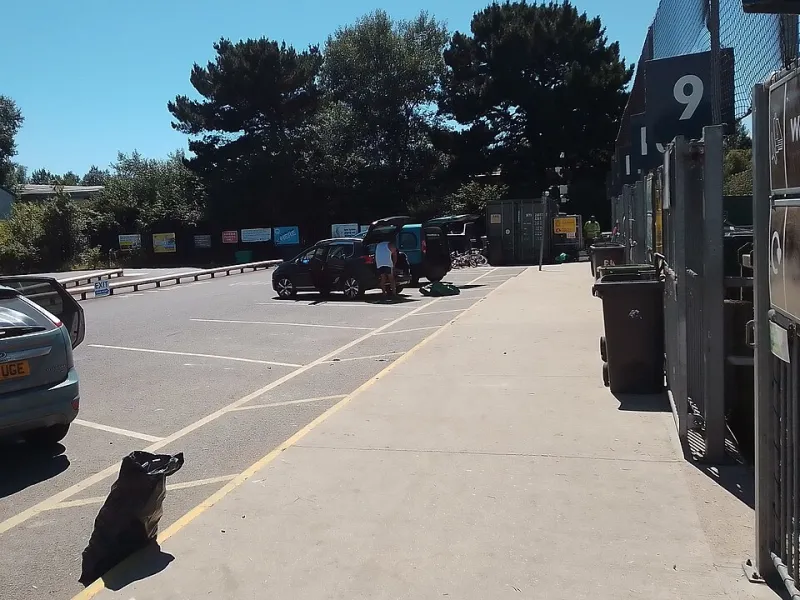
Photo: Djm-leighpark, CC BY-SA 4.0, via Wikimedia Commons
I did not expect to make small talk over a dismantled chest of drawers. But that is the thing about the household waste and recycling centre: it is not just a place you go to throw things away. It is a place where things arrive, get judged, and sometimes get a second chance. I spent four Saturdays at our local council site this autumn, mostly loitering near the reuse shop, and came away with more than a £4 bedside lamp. I came away with a new respect for the weighbridge.
The gate has a rhythm
Saturday morning at the centre has a choreography you only notice if you stand still. Cars queue in a neat, slightly tense line. People check booking slots on their phones. Staff in hi-vis point vans towards the hardcore bay and direct first-timers away from the wrong skip. There is a lot of reversing, a lot of handbrake turns, and a surprising amount of patience.
The etiquette is unspoken but firm. You do not unload before you are asked. You do not hover behind someone who is clearly having a clear-out crisis. You ask before you take anything from a boot, even if the owner is already walking away. You keep children close and your trailer permit visible. And if something still works — really works — you do not chuck it. You carry it to the shop.
That last rule is the one that changes the whole place. The tip is not a single destination. It is a sorting office for the town’s intentions.
The shop behind the skips
The reuse shop at our centre is a small portacabin with shelves that smell faintly of furniture polish and old rain. On any given Saturday you might find a row of matching mugs, a bike with one brake, three puzzles missing different pieces, a hedge trimmer, a stack of DVDs, and a lamp shaped like a pineapple. It is charity-shop logic with a skip behind it.
The staff triage donations with a professional eye. If it plugs in, they are cautious. If it is broken, they are honest. If it is merely unfashionable, they price it at £2 and put it near the door. Nothing is precious, but nothing is worthless either. A handwritten label is the only marketing budget.
What I liked most was the queuing. Not the car queue outside — the second-life queue. People arrive with a boot full of things they feel mildly guilty about discarding, and leave with something else. A retired teacher bought a reading lamp for a chair she keeps by the window. A young couple kitting out a first flat carried away a stack of plates and a toast rack. A man in a fleece inspected a bicycle frame for five minutes, then bought it for £8 and wheeled it out with the quiet satisfaction of someone who knows exactly which shed it is going to.
A small economy of rescued things
The prices are not the point, but they matter. A £3 kettle is a small rebellion against the idea that everything must be new. A £15 mower is a Saturday morning saved. The shop does not pretend to be a solution to waste; it is more modest than that. It is a holding bay for objects that have not finished being useful.
In 2026, when next-day delivery is normal and broken things can feel disposable, that is a quietly counter-cultural position. The reuse shop is not preachy about it. There are no lecterns, no carbon-calculator screens, no one wagging a finger. There is just a shelf of rescued things and a sign that says please ask for help. Somehow that is more persuasive than any campaign.
The regulars know the rhythm. They come early for the good bikes. They know which member of staff will hold something behind the counter for ten minutes. They know that a rainy Saturday means more donations and fewer browsers, and that a sunny one means garden furniture will be gone by lunch. It is a small economy, but it has its own weather system.
The staff who see the town’s habits
The people who work at the centre see the town in a way the rest of us do not. January brings exercise bikes and diet books. Spring brings fence panels and patio heaters. September brings student clear-outs and the sad procession of furniture from rented flats. Christmas brings an avalanche of cardboard and the occasional unopened gift set that nobody wants to explain.
One of the staff told me they can tell what kind of week the town has had by what arrives on a Monday. They are not being nosy; it is just the job. They develop a professional eye for the almost-broken, the nearly-loved, and the wildly optimistic second-hand sofa.
They also develop a certain diplomacy. The centre is not a place for judgment. People come in with guilt, grief, haste, or a van full of stuff from a house clearance. The staff meet all of it with the same flat, friendly efficiency. It is one of the last public services where you can turn up with a mess and be told, without drama, which bay to use.
What the weighbridge knows
The tip is a mirror. It shows you what a town buys, what it tires of, and what it cannot quite bring itself to throw away. The reuse shop is the softer edge of that mirror. It turns a council site into a social space, a Saturday ritual, and a small second chance for things that were nearly landfill.
I went in with a boot full of guilt and came out with a lamp, a wooden stool with a wobbly leg, and a conversation about whether a 1990s food processor counts as vintage. I fixed the stool. The lamp works. The food processor is still there, if you are interested.
That is the whole point, really. The second-life queue is not just about saving objects. It is about the quiet, ordinary pleasure of finding something that still has a bit of use left in it — and a town that knows where to take it.