Everything Must Go (Except the Chat): Four Weeks on a Charity Shop Till
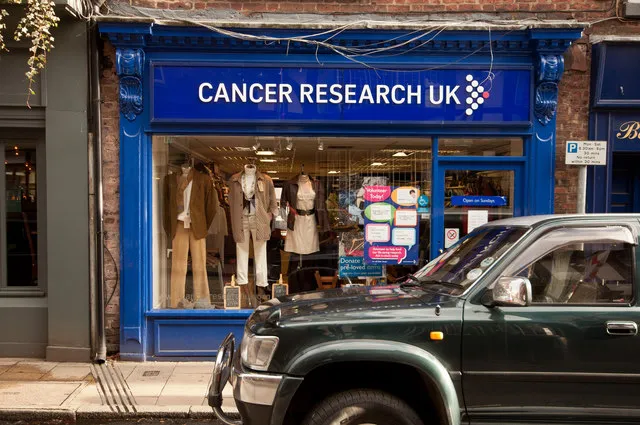
Photo: Roger A Smith , CC BY-SA 2.0, via Wikimedia Commons
The first thing you learn on a charity shop till is that the till is not really a till. It is a counter, a confessional, a lost-property desk and a weather station. The second thing you learn is that somebody will be outside the door at 9:05am, twelve minutes before opening, holding a vase and a question about whether we take defective kettles. We do not. They will ask again next week.
I spent four weeks volunteering in my local shop — two days a week on the till, a handful of mornings in the back room — because I wanted to understand the £1.50 economy. Not the big-number economy of interest rates and quarterly reports. The one that runs on pocket change, carrier bags and the quiet arithmetic of what a person can afford on a Tuesday.
The sorting room is the real high street
The back room smells of steamed wool and old paper. Donations arrive in bin bags, carrier bags, laundry baskets and, once, a plastic toy wheelbarrow. You open them like disappointing presents. A pair of curtains. Three mugs. A Danielle Steel paperback with a sun-faded cover. A single ski boot. A framed print of a Highland cow that has clearly been in a loft since the first wave of Highland cow enthusiasm.
The sorting process is not glamorous, but it is strangely hopeful. You are looking for the thing that will sell. A decent coat in October. A set of matching glasses. Anything with a recognisable brand and no holes. The rest goes into rag, recycling or, occasionally, the bin — and yes, we feel guilty about the bin.
People imagine charity shops are stuffed with antiques. Mostly they are stuffed with the ordinary debris of British domestic life. That is why they work. They are a second-chance system for the things we all own too much of.
How a price gets decided
On the shop floor, pricing is part science, part vibes and part local knowledge. A paperback is usually £1 or £1.50. A jigsaw is £2 if it looks complete, £1 if it rattles suspiciously. Branded sportswear gets checked on the phone, because someone will otherwise buy it for £4 and sell it on for £40. A Wedgwood plate gets put aside for the manager. A mug with a cartoon cat on it gets 50p and sells before lunch.
The £1.50 transaction is the one I kept thinking about. It turns up constantly. A paperback and a birthday card. A children's T-shirt and a plastic toy. A pair of earrings and a DVD. It is small enough to be an impulse, large enough to keep the lights on. In 2026, when a single coffee can cost more than a hardback and a pair of jeans, £1.50 feels like a small act of defiance.
We are not a charity in the abstract. The money goes to a specific cause, and customers ask about it. They want to know where the profit goes. They want to know if the volunteers are paid. They want to know why the shop is closed on a Wednesday. Fair enough. It is their shop as much as ours.
The regulars know the opening time better than we do
There is a man who comes in every morning to check the music section. There is a woman who buys any ceramic animal under £3 and has, by my estimate, a spare bedroom full of them. There is a bloke who calls everyone 'chief' and never buys anything, but once fixed the door closer with a screwdriver from his own pocket.
Then there are the quiet ones. The ones who come in for the warmth. The ones who ask if we have any men's coats in a medium and then tell you about their son in Leeds. The ones who buy a single card and stay for ten minutes. The ones who come in because the bus is late, or because the flat is quiet, or because they have just moved to the area and the charity shop is the only place that does not require an appointment.
You cannot put that on a spreadsheet. You can put it on a sign, though. Something like: 'You don't have to buy anything.' We never did, but it was true.
The honest square
Charity shops are often described as a high-street survivor. That is true, but it undersells them. They are also a recycling scheme, a loneliness service, a cheap clothes shop, a volunteer placement and a place where a £1.50 note — sorry, coin — changes hands without anyone feeling small.
There is a particular honesty to the transaction. Nobody is upsold. Nobody is asked to add a side. Nobody is made to feel like they have failed at shopping. You find a thing, you pay for it, you leave with it in a bag that has already had one life. The shop gets a few quid for a cause. You get a paperback, a mug and a brief chat about the weather. Everybody wins, slightly.
The high street in 2026 is a strange, patchy thing. Some towns have more vape shops than greengrocers. Some have coffee shops where the bank used to be. But most still have a charity shop, and most of those shops are run by people who know the price of everything and the value of a good natter.
After four weeks, I came away with a £2 jumper, a 50p copy of a book I already owned, and a new respect for the phrase 'every little helps'. Not the supermarket version. The real one. The one that starts with a bin bag on a doorstep and ends with someone saying, 'See you next week, love.'
If you have a spare morning, go and ask if they need a hand. The till will teach you more about your town than any council report. And if you see a single ski boot, mind your own business.